The city is the farm
Thousands of small sites — none of them self-sufficient — operate as one coordinated production network.
 Gatherly SFNeighborhood Food InfrastructureSan Francisco · 5 years · $50M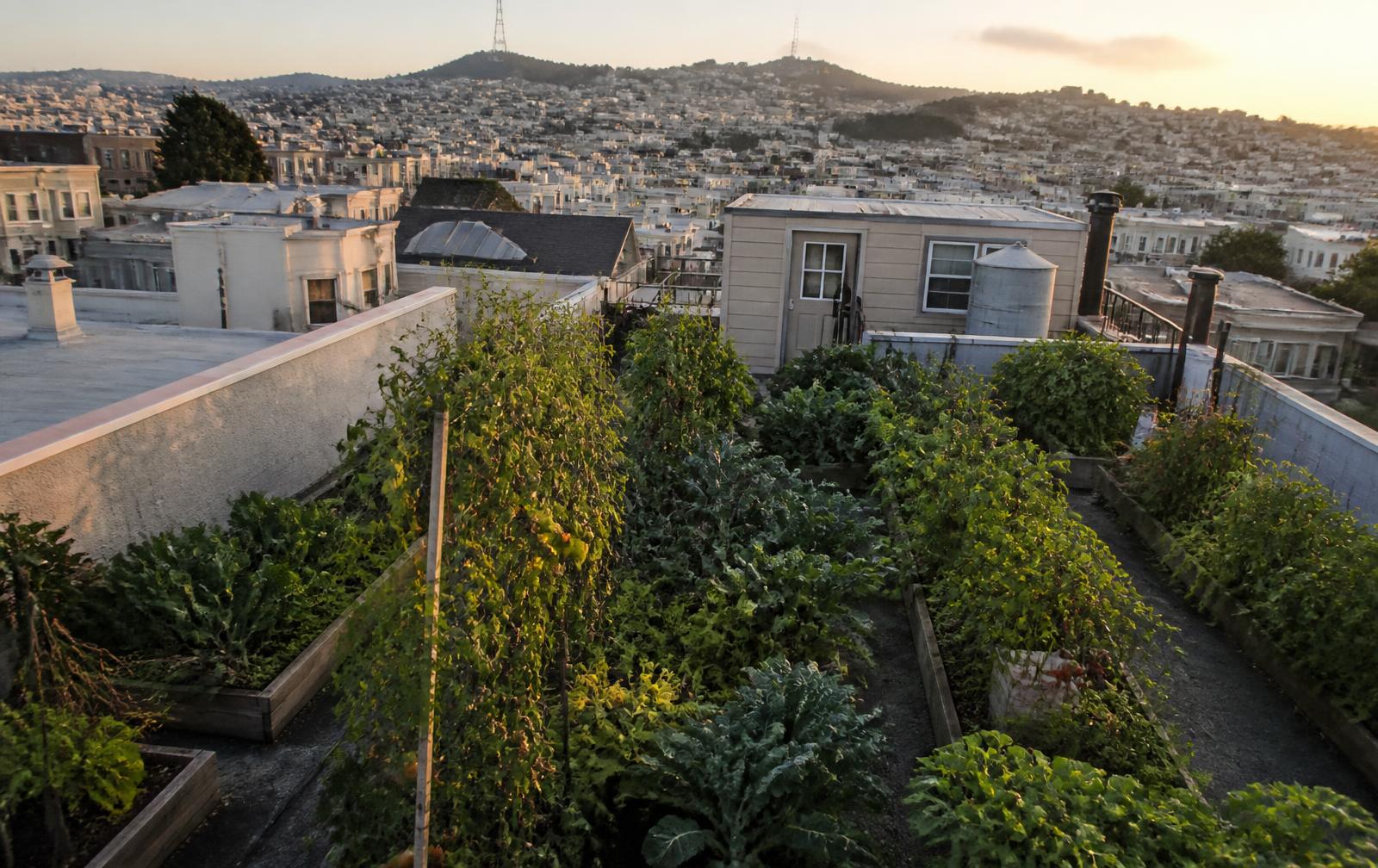
A blueprint for a city that helps feed itself
Roads, water, power, transit, broadband, parks, schools, housing — cities built all of it. Food never became infrastructure. San Francisco can be the first city to build it, neighborhood by neighborhood.
The vision
Rooftops, backyards, balconies, vacant lots, schoolyards, public housing courtyards and unused commercial land become part of a distributed network for growing food.
Residents stop being only consumers at the end of a long global supply chain and become participants who produce, distribute, prepare, preserve and benefit economically from the food grown around them.
Corner stores become neighborhood food hubs. Community kitchens turn surplus tomatoes into sauce, cucumbers into pickles, imperfect vegetables into soups and frozen meals. The money circulates back into the neighborhoods that grew the food.
What Gatherly SF is
A new layer of civic infrastructure: a distributed neighborhood food system producing health, income, resilience, ownership and dramatically less waste.
The economy we are replacing
Buy → Consume → Discard
Grow → Harvest → Sell → Cook → Preserve → Reinvest
Design principles
Thousands of small sites — none of them self-sufficient — operate as one coordinated production network.
Neighborhoods plan crops by season so the outcome is collective abundance instead of duplicated effort.
SNAP/EBT, nutrition incentives, produce prescriptions and subsidized boxes keep neighborhood food from becoming a premium product.
Feed people first, preserve or transform edible surplus second, compost what remains, and return nutrients to the soil.
Stipends, wages, revenue sharing and business ownership replace unpaid volunteerism.
San Francisco is the first laboratory; the architecture is designed for cities everywhere.
The neighborhood food grid
Backyards, rooftops, balconies, community gardens, schoolyards, public housing courtyards, faith properties and shared neighborhood farms.
Neighborhood points where food is weighed, sorted, cooled, stored and aggregated into one supply.
Corner stores and independent markets become Neighborhood Food Hubs selling produce, boxes, meal kits and prepared food.
Licensed community kitchens turn surplus into sauces, pickles, preserves, soups and frozen meals — and incubate resident-owned brands.
Vehicles, cold storage and short distribution routes that keep food moving while it is still at its best.
One platform mapping spaces and coordinating crops, demand, harvests, inventory, grower payments and measured impact.
Residents trained and paid as growers, coordinators, cooks, drivers, educators, entrepreneurs and food-system leaders.
The investment
A $50 million investment to build the first citywide Neighborhood Food Infrastructure system in America: transforming rooftops, backyards, vacant spaces, corner stores and community kitchens into a distributed network for growing food, creating jobs, reducing waste and improving health.
| Investment area | Yr 1 | Yr 2 | Yr 3 | Yr 4 | Yr 5 | Total |
|---|---|---|---|---|---|---|
| Core team + neighborhood operator grants | $1.50 | $2.00 | $2.40 | $2.60 | $2.50 | $11.00 |
| Residential + community growing infrastructure | $0.80 | $1.30 | $1.70 | $1.80 | $1.40 | $7.00 |
| Rooftop + vacant/underused-space urban farming | $0.80 | $1.40 | $2.00 | $2.20 | $1.60 | $8.00 |
| Community kitchens + processing equipment | $0.40 | $0.80 | $1.20 | $1.40 | $1.20 | $5.00 |
| Corner-store / Food Hub upgrades | $0.20 | $0.50 | $0.70 | $0.80 | $0.80 | $3.00 |
| Collection, vehicles, refrigeration + cold chain | $0.30 | $0.70 | $0.90 | $1.10 | $1.00 | $4.00 |
| Resident stipends, jobs + workforce training | $0.25 | $0.55 | $0.80 | $1.10 | $1.30 | $4.00 |
| Technology, mapping, data + AI platform | $0.45 | $0.50 | $0.40 | $0.35 | $0.30 | $2.00 |
| Engineering, permits, insurance + food safety | $0.35 | $0.45 | $0.40 | $0.40 | $0.40 | $2.00 |
| Community engagement + impact evaluation | $0.10 | $0.20 | $0.25 | $0.25 | $0.20 | $1.00 |
| Contingency + innovation reserve | $0.55 | $0.60 | $0.65 | $0.65 | $0.55 | $3.00 |
| Total | $5.70 | $9.00 | $11.40 | $12.65 | $11.25 | $50.00M |
All figures in millions of USD. Catalytic capital — not the total economic activity of the system.
The $8M rooftop and underused-space line funds site identification, structural-load, waterproofing, access, fire-safety and irrigation review, then installations. It does not fund major structural renovation of buildings never designed for farming — those projects should draw building-owner, climate, housing and green-infrastructure capital.
By Years 3–5 the network generates revenue from produce, packaged foods, institutional purchasing, retail, kitchen businesses, subscriptions, health-system partnerships and platform licensing. That revenue is reinvested — the budget does not depend on it to balance.
Five-year rollout
Year 1
~20% of neighborhoods active — entire city mapped
Map rooftops and vacant land, set engineering and food-safety standards, launch the first growing clusters, first community kitchen, first Food Hubs, and build the coordination platform.
Year 2
~45% of neighborhoods
Expand residential farming, rooftop sites and shared farms. Add stores and kitchens, establish collection routes, and begin producing branded upcycled food products.
Year 3
~70% of neighborhoods
Large expansion of rooftops and growing sites, stronger production coordination, and growth in workforce programs, institutional purchasing and commercial products.
Year 4
100% of San Francisco neighborhoods
Every neighborhood reaches the network through growing sites, collection points, Food Hubs, kitchens or connected distribution infrastructure.
Year 5
100% coverage, optimized
Improve economics, deepen resident ownership, grow food businesses, measure impact, and package the model for replication by other cities.
The promise is not that every rooftop becomes a farm. It is that every viable space is considered and every neighborhood participates.
2,500
Active growing sites
Residential yards and shared community sites
100–120
Rooftop / underused-space farms
Engineered, permitted, production-scale
8+
Community kitchen hubs
Processing, preservation, business incubation
150
Neighborhood Food Hubs
Corner stores and independent markets
Plus a citywide collection, cold-storage and technology network connecting all of it.
Leadership
Maen Mahfoud will lead the SF Neighborhood Food Infrastructure, bringing a rare combination of lived experience, systems thinking, technology, public health, and food-sector leadership to the work. Having immigrated to the United States with firsthand knowledge of how food systems operate in the developing world, Maen has long understood that some of the most powerful innovations do not always move from wealthy countries outward; they can also move in reverse, with resource-efficient, community-centered models from the developing world informing solutions in wealthier cities — a concept known as reverse innovation, which he explored in his graduate thesis and later published through The BMJ. That perspective has shaped his approach to food systems ever since.
In 2016, he founded Replate after seeing the contradiction of enormous food abundance and food insecurity existing side by side, and grew it from a local Bay Area idea into a technology-enabled food recovery platform operating nationally and internationally through its partnerships and programs. Through Replate, Maen has gained direct experience coordinating businesses, institutions, logistics networks, nonprofits, technology, data, and communities around a common food-system challenge.
Gatherly SF is the natural evolution of that work: moving upstream from recovering surplus food after waste occurs to redesigning how cities grow, distribute, process, preserve, and reinvest food from the beginning. His experience as an immigrant, entrepreneur, public-health thinker, and builder of a nationally and internationally scaled food platform positions him to lead San Francisco in developing a new model of urban food infrastructure — one that draws on lessons from both the developing and developed worlds and can ultimately be replicated by cities around the globe.
Education & accomplishments
Maen's expertise is reflected in both his academic background and professional recognition. He is a Princeton University Sugarman Practitioner-in-Residence, a 2025 finalist for Sustainability Champion of the Year with the San Francisco Chamber of Commerce, and a 2023 James Irvine Leadership Award recipient. He holds a Master's in Public Health from Imperial College London and a degree in Molecular Biology from UC Berkeley, along with an HCI for UX Design Certificate from MIT and SPNM executive education from Harvard Business School. His graduate work on reverse innovation was published through The BMJ, reflecting his longstanding interest in how solutions and practices from resource-constrained settings can inform innovation in wealthier health and social systems. Maen is also a co-inventor on Replate's U.S. patent application for “Systems, Methods, and Graphical User Interfaces for Donating Surplus Food,” technology designed to support scalable surplus-food donation and recovery infrastructure.
Board & affiliations
Board Member, Ideagarden Institute
We equip emerging leaders driven to transform food systems with the resources they need to thrive.
Our north star
Every neighborhood should have the capacity to grow, recover, process, distribute and create economic value from a meaningful share of its own healthy food.
The future city does not merely consume. It grows. It shares. It preserves. It creates. It regenerates. And ultimately, it helps feed itself.